


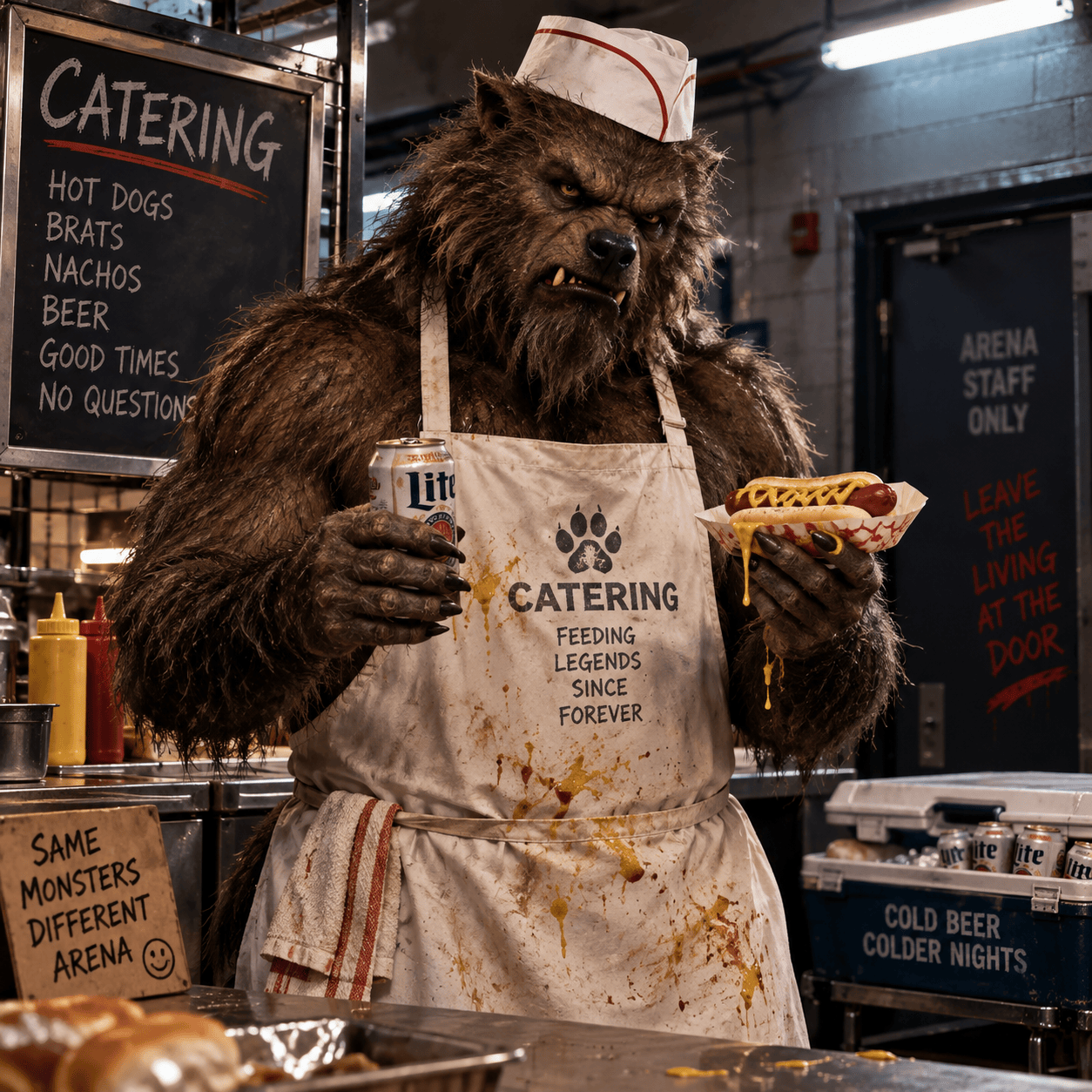
Catering is serving hot dogs tonight.
This would not normally qualify as news, except the man serving them is a werewolf.
Big guy. Seven feet if he’s an inch. Hair everywhere. Wearing a white apron and one of those little paper food-service hats that looks ridiculous even before you account for the snout.
I’ve learned not to ask questions.
“One dog,” I tell him. “Mustard. And a beer.”
He growls.
I point at the cooler behind him.
“The Promoter pays you to work catering. He pays me to call matches. Neither of us needs to make this harder than it already is.”
The werewolf considers this, then slides a beer across the counter.
Professional courtesy.
I’m halfway through dressing the hot dog when the buzzer sounds.
BWAAAAAAAH.
Every light in catering flickers.
Damn it.
Match time.
I grab the hot dog, tuck my notepad under one arm, hook two fingers around the neck of the beer and start moving. The corridors are already changing around me. Concrete becomes painted cinder block. Fluorescent lights buzz overhead. Somewhere beyond the walls, thousands of people are making enough noise to shake dust from the ceiling.
I push through the curtain and stop.
Pittsburgh Civic Arena.
The place is packed.
Mostly.
There are always a few seats here reserved for the dead.
I make my way down toward my commentary position, squeezing past a collection of translucent wrestling fans who apparently never got the memo that haunting an arena does not entitle you to extra legroom. One of them is wearing an Austin 3:16 shirt. Another looks like he’s been waiting for this match since approximately 1974.
“Scoot.”
They scoot.
I drop into my chair, set down the beer, balance the hot dog precariously beside my notepad and look toward the ring.
Then the lights change.
Above us, steel begins to descend.
My hot dog stops halfway to my mouth.
Oh, no.
I know that Cell.
I know this building.
And I know exactly what night the Promoter has decided I need to witness.
June 28, 1998.
King of the Ring.
The Undertaker.
Mankind.
Hell in a Cell.
I stop chewing, the hot dog hanging there dripping mustard, mesmerized by the slow descent of the Cell.
This was only the third WWF Hell in a Cell match. The stipulation was still young, defined chiefly by The Undertaker and Shawn Michaels turning a cage match into a gothic blood feud at Badd Blood less than nine months earlier. Its meaning was still being written.
Then Mick Foley and Mark Calaway gave it a meaning so dangerous that the match has spent more than a quarter-century casting a shadow over nearly every Cell bout that followed.
Undertaker vs. Mankind is not simply wrestling’s most famous stunt match. It is where intended spectacle repeatedly collided with genuine physical peril, where the audience could feel the difference, and where the performers continued after the illusion stopped containing reality. It is magnificent. It is horrifying. And if your takeaway is that wrestling needs someone to do it again, brother, you watched it with your eyes closed.
Hell in a Cell Was Supposed to Keep the Violence In


Foley’s Mankind was not Shawn Michaels. Michaels and Undertaker gave the original Cell athletic drama, blood and escalating grudges. Mankind’s strength was something else: unpredictability, ugliness, desperation, the sense that this man might hurt himself just to make you uncomfortable.
By Foley’s later recollection, Terry Funk helped plant the seed for taking the action onto the roof. Foley had originally considered a rooftop elbow drop. The eventual concept was more direct and terrifying: start atop the Cell and turn the structure itself into the battlefield.[^1]
That is perfect Mankind psychology. Hell in a Cell was supposed to keep violence in. Mankind’s first act was to climb on top of it and make containment somebody else’s problem.
He throws a chair onto the roof before Undertaker joins him. The ring is below them, but the ring is not the point. The Cell is the point.
And then Undertaker throws him off it!
The First Fall: A Performer-Level Plan That Looked Like Death
Foley plunges from the roof through the Spanish announce table, and the shot still carries the force of a live wire.

The fall was discussed by performers but apparently was not a fully communicated production cue. Foley and Funk recalled conceiving the rooftop material, while Jim Ross, referee Tim White and Sgt. Slaughter later said they had not been specifically told Foley would be thrown from the Cell.[^1] That does not prove nobody in management knew. Wrestling folklore loves turning incomplete information into a courtroom verdict. It establishes that key people at ringside were not calmly awaiting a scheduled cue.
Do not get hung up on the exact height; accounts have varied. What is indisputable is the image: a man goes from the roof of a giant steel enclosure to the floor, through a table that does not soften the impact so much as make the violence legible. Foley disappears into wreckage like a meteor of flesh and mangled hair.
From this impossible commentary position, I can hear the Civic Arena reaction change in seconds: a massive roar at the fall, then a stunned, unsettled atmosphere as the seriousness becomes clear. This does not look spectacular in any reassuring sense. It looks catastrophic. At this point, I wonder, Jesus Christ. Is Foley dead?!
Ross understands that instantly. His call—“As God is my witness, this man has been broken in half!”—became immortal because he did not call the fall like a stunt. He called it like an emergency. Ross later said the words were unscripted and that he had not known the fall was coming.[^1]
Medical personnel attend to Foley. The Cell is raised for access. He is placed on a stretcher.
And then . . .Foley gets off it!
What the fuuuuck?!
When Mankind Became Mick Foley


White later recalled Foley telling him he was “good to go.” Slaughter remembered trying to get
medical attention to Foley and move him toward the back.[^1] Neither recollection should be mistaken for a modern medical clearance. But Foley chose to continue.

The mask came off during the medical aftermath. Foley later described that detail as emotionally significant: without it, he stopped being only Mankind and became visibly, vulnerably Mick Foley.[^1]
When he rises and begins climbing again, the audience response shifts toward renewed awe and alarm. The crowd has seen through the gimmick. Mankind is no longer merely a monster to be defeated. He is a human being the building has watched become frighteningly vulnerable.
That is match psychology at its rawest. Foley’s agency deserves respect. It does not erase wrestling’s broader pressures, where being unforgettable can become part of the job description and “he wanted to do it” can become a dangerously convenient sentence.
The kind of sentence long-horned promoters love to hear.
The Second Fall: A Plan Goes Wrong
The most repeated version of this match’s history says the first fall was planned and the second was not.

It is not that simple.
Undertaker chokeslams Foley on the Cell roof. The panel gives way, and Foley crashes through it into the ring. He is knocked unconscious. The chair also falls into the ring. Foley sustains serious facial and dental injuries among the damage he later recounts.[^1]
His recollections require care. In WWE’s retrospective oral history, Foley said his vision “did not include the cage breaking” as it did. In another later account, he said he had anticipated some slower tearing or give—a visual in which he might hang or descend more gradually—rather than the immediate collapse that occurred.[^2]
Those accounts are not necessarily incompatible. Some give may have been anticipated. The sudden, complete opening beneath him was not.
The Cell’s failure was not a magic trick revealed by hindsight. It was a dangerous plan becoming more dangerous in the instant it went wrong.
Foley later argued that Undertaker’s unusually low chokeslam may have saved him. Because he did not get the height and rotation of a typical chokeslam, Foley landed on his back rather than his head or neck.[^1] That sentence should stop every wrestling fan from romanticizing the moment for a beat.
We are talking about survival geometry.
Back at the desk, the air after the second fall is different—not silent, but stripped of the clean excitement a wrestling crowd knows how to produce. You can see the craft and commitment. You can also see where neither is enough to make the footage comfortable.
Undertaker’s Job Changed Mid-Match

Calaway’s performance is sometimes reduced to a cruelly simple sentence: he threw Mick Foley off a cage.
No. He was the indispensable other half of the match.
Undertaker begins as the monster at the center of the spectacle. After the second fall, however, the bout has a problem no character work can solve. Foley is hurt. The audience is rattled. The match still needs a path to an ending.
Ringside witnesses later recalled Undertaker checking whether Foley could continue. White remembered Undertaker telling him to make sure Foley was breathing; Slaughter recalled Undertaker repeatedly asking whether Foley would continue.[^1] Those are retrospective accounts, not a transcript of every decision inside the Cell.
This is my reading of Calaway’s performance, not a documented backstage instruction: somewhere around that second collapse, Undertaker’s job stopped being simply “destroy Mankind.” It became keeping the match from becoming total cataclysm.
But imagine the box office?!
Terry Funk enters amid the confusion and gets chokeslammed, briefly changing the match’s rhythm. The interruption gave Foley time. We do not need to invent private motives for anyone to recognize its value.
A Conventional Finish After an Unconventional Disaster

Eventually, the match returns to wrestling’s familiar escalation ladder: weapons, thumbtacks, finishing moves. Undertaker chokeslams Mankind into the tacks and ends it with the Tombstone Piledriver.
Undertaker wins!
There is something surreal about the conventionality of that finish. A pinfall. A bell. A winner. The machinery of a wrestling match attempting to place a border around an event that had overflowed every border available to it.
Foley later described a concussion, dislocated shoulder and jaw, bruised ribs, internal bleeding, puncture wounds and damaged teeth. Those details come from Foley and later reporting, not a contemporaneous medical chart.[^1][^3] They are not an invitation to inventory suffering like a collector cataloguing trading cards. They are the reason we need to be honest about the match.
Foley and Ross have both suggested that a comparable match would be stopped under modern conditions.[^1] Wrestling is safer when that is true.
The Mythology—and the Trap It Built

Undertaker vs. Mankind did not invent hardcore wrestling. Let us put that nonsense in a body bag and roll it out of the building.
Hopefully I can sneak out with it…
Japanese deathmatch traditions had already pushed violence and spectacle into extreme territory. ECW made weapon-heavy brawling a prominent American alternative. Foley himself worked a brutal style in WCW, Smoky Mountain Wrestling and Japan before becoming a WWF star.[^4][^5]
What this match did was place extreme, visibly dangerous spectacle at the center of a major WWF pay-per-view during the Attitude Era. It did not create hardcore wrestling. It became one of its most enduring mainstream images.
It also became an impossible benchmark. Shane McMahon’s 2016 Hell in a Cell match with Undertaker, built around Shane’s leap from the Cell, shows how thoroughly the stipulation became associated with the demand for a towering visual.[^6] That is the poisonous part of the legacy: a moment legendary partly because it was uncontrolled, frightening and singular gets treated as an escalation target.
Foley has resisted calling this the greatest match ever. “Most compelling” is closer to his assessment.[^1] This match has technical execution, character work, crowd control and emotional honesty in uneven but extraordinary quantities. It is not a blueprint. It is the lightning strike that cemented Mick Foley into immortality.
As the Cell hangs over the ring in this impossible arena, I can feel why the footage still holds us: the scale, the storytelling, Foley’s courage, Undertaker’s control, Ross’s alarm, a crowd realizing it may be watching something it cannot safely enjoy.
You can call it mythic. You can call it unforgettable. But greatness is not regulated to a safety standard, and the curse of legend has no medical plan.
Thanks for Reading!


If you made it this far, congratulations. You survived Hell in a Cell with considerably fewer missing teeth than Mick Foley.
I’m Brenna Steele, coming to you from somewhere inside The Arena, where the beer is cold, the catering staff occasionally howls at the moon, and The Promoter still hasn’t explained my benefits package.
If you enjoyed this little trip through wrestling history, stick around. I’ve got an entire arena full of matches waiting for me, and apparently dying doesn’t even get you out of buying a ticket around here.
Until next bell…
Keep your shoulders off the mat.
— Brenna Steele
Ringside Correspondent, Cryptic Escape
A Note From Management
Brenna Steele is a fictional character and, despite several strongly worded complaints concerning overtime, hazard pay, and the questionable employment practices of The Promoter, remains a member of the Cryptic Escape staff.
Brenna was created as part of Cryptic Escape’s experiment in character-driven criticism, allowing each of our writers to approach horror, science fiction, fantasy, gaming, wrestling, and other corners of popular culture from their own peculiar perspective.
Any resemblance to an actual wrestling journalist, commentator, historian, manager, wrestler, promoter, or person currently trapped inside a supernatural arena is purely coincidental.
Historical events, quotations, match details, and sources are checked to the best of our ability. Brenna’s experiences inside The Arena, including spectral wrestling fans, impossible recreations of historic matches, werewolves working catering, and employment agreements of dubious legality, should probably not be considered historical evidence.
Cryptic Escape uses AI-assisted tools as part of our creative and editorial process, including research organization, drafting, editing, and artwork. Every published article is reviewed, edited, and approved by a human editor. Final editorial decisions, opinions, creative direction, and responsibility for the published work belong to Cryptic Escape.
— Management
Sources/Research Notes
[^1]: WWE, “To Hell and Back: The Oral History of Foley’s Famous Fall,” June 27, 2018. Retrospective corporate oral history featuring Mick Foley, Jim Ross, Tim White, Sgt. Slaughter and others. https://www.wwe.com/classics/oral-history-foleys-famous-fall
[^2]: Wrestling Inc., “Mick Foley on Lying to Vince So He Could Take ‘Hell in a Cell’ Bumps,” April 2017. Secondary report of Foley’s later roof-tearing recollection. https://www.wrestlinginc.com/news/2017/04/mick-foley-on-lying-to-vince-so-he-could-take-hell-in-a-625064/
[^3]: ESPN, “How WWE Hall of Famer Mick Foley Smiles Through His Chronic Pain,” May 2020. https://www.espn.com/wwe/story/_/id/29282932/mick-foley-feels-your-pain-too
[^4]: David Shoemaker, The Squared Circle: Life, Death, and Professional Wrestling. Gotham Books, 2013.
[^5]: Mick Foley, Have a Nice Day: A Tale of Blood and Sweatsocks. ReganBooks, 1999.
[^6]: WWE, “The Undertaker’s History in Hell,” official Hell in a Cell chronology. https://www.wwe.com/classics/undertaker-hell-in-a-cell-history