

How Orson Welles and the Mercury Theatre turned radio’s authority into terror—and how a limited scare became the legend of nationwide panic.
By Midnight Mike
It was getting late up on Raven Rock, babies.
Real late.
That special kind of late where the coffee’s gone cold, the bugs are throwing themselves against the studio windows, and every respectable soul in Morrigan’s Crossing has either gone to bed or started doing something they don’t want their neighbors knowing about.
Which means, naturally, it was just about my favorite time of night.
This is Midnight Mike coming to you live from KPHO, where the records keep spinning, the transmitter keeps humming, and management keeps insisting that whatever lives underneath the station is “probably just the pipes.”
Sure.
I was reaching for another record when something crawled across the board.
Static.
Not regular static, either.
This stuff had age on it.
Dry. Thin. Scratchy. Like somebody had taken seventy years of dead air, stuffed it into a coffin, and cracked the lid open just enough for it to breathe.
“Ooooooh, what have we got here?”
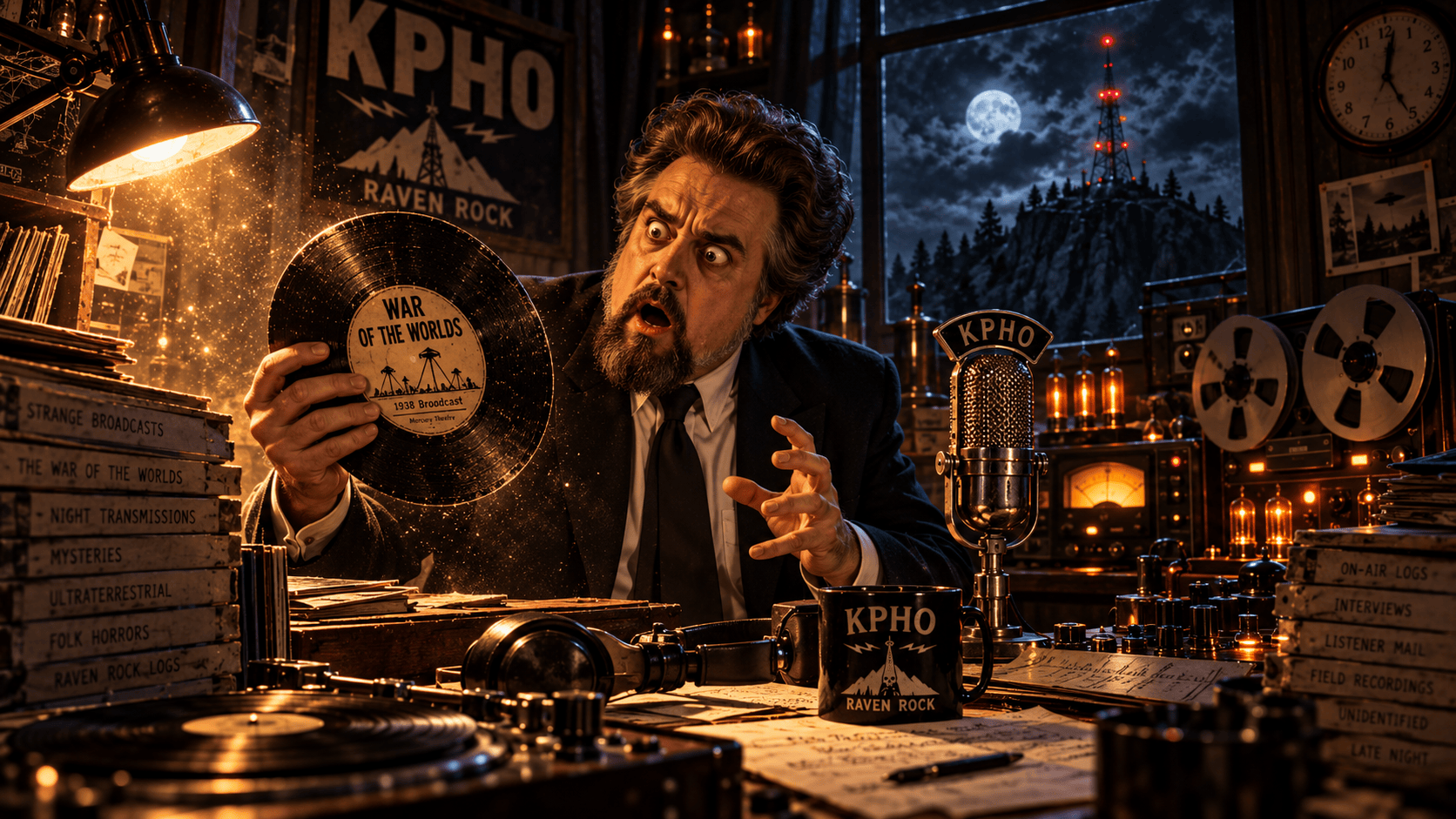
I rolled my chair closer.
The static cleared.
Music came through.
Sweet little dance-band number. Horns. Strings. The sort of thing your grandparents might’ve danced to before somebody invented distortion pedals and ruined civilization properly.
I grinned.
“Well, hello there, sweetheart. You’re a long way from home.”
At first I figured somebody was rebroadcasting an old recording.
Wouldn’t be the strangest thing I’d picked up after midnight.
Then the music stopped.
A voice came through.
Calm. Professional.
A bulletin.
I stopped smiling.
The music returned.
Then another bulletin cut it off.
I looked at the clock.
Looked at the board.
Then slowly leaned toward my microphone.
“Okay, night people! Midnight Mike needs everybody to keep those hands where I can see ’em and stay away from that dial.”
Another burst of static hissed through the headphones.
And suddenly I knew exactly what I was hearing.
October 30, 1938.
CBS.
Orson Welles.
The War of the Worlds.
Only there was one little problem.
This didn’t sound like a recording.
It sounded live.
And ladies and gentlemen…
that broadcast had been dead for nearly ninety years.
Welles was 23 years old. The Martians were fictional. The fear, for at least some listeners, was very real.
But the legend that grew around it—the tale of an entire nation stampeding into the streets—is another creature altogether. That monster did not merely emerge from a cylinder at Grovers Mill. It grew in headlines, studies, retellings, and the American imagination.
The Bulletin That Ate the Music

Let us get one fact onto the operating table before the lightning strikes: The War of the Worlds identified itself at the beginning. The announcement named Welles, the Mercury Theatre, and H. G. Wells’s story. Welles followed with literary narration adapted from the 1898 novel.
This was not an unmarked hour of counterfeit news.
What followed, however, was a devilishly persuasive drama that borrowed the sounds, pacing, and authority of a live emergency.
After the introduction, the program settled into the rhythms of an ordinary evening broadcast: a weather report, then music by “Ramon Raquello and his orchestra” from the fictional Park Plaza Hotel. Reports of disturbances on Mars began to intrude.
Then the music stopped.
A bulletin.
Then music again.
Then another bulletin.
The trick was interruption and return. Every restoration of the dance band gave listeners a patch of solid ground. The next bulletin tore it away.
Koch’s adaptation moved Wells’s invasion from Victorian England to contemporary New Jersey. A supposed meteorite falls near Grovers Mill—the broadcast script’s spelling, though the local place is commonly rendered Grover’s Mill. Reporter Carl Phillips, played by Frank Readick, describes the cylinder and its opening.
Then comes the heat ray.
Then the microphone crashes.
Then silence.
Ah, that silence.
That is a microphone face-down in the dirt while the audience supplies the expensive special effects. The fictional announcer reports difficulty with the field transmission; no real CBS transmitter had failed. Inside the drama, however, the break in contact makes catastrophe seem to have swallowed the reporter whole.
The production’s peculiar terror comes from calm, official-sounding voices delivering impossible news. Bernard Herrmann’s music; the sound effects of Ora Nichols, Ray Kremer, and Jim Rogan; John Dietz’s engineering; Paul Stewart’s announcing—all helped construct a sonic machine in which institutional authority became part of the horror.
Why It Sounded Like History

Only a month earlier, the Munich Crisis had made radio interruptions part of the public’s emotional weather. Americans had heard regular programming cut away for urgent reports about Europe and the threat of war. The Library of Congress identifies that recent conditioning as one reason the Mercury program’s bulletins were so effective.
In 1938, a bulletin clawing through dance music did not sound like a Halloween novelty. It sounded like trouble kicking down the studio door.
There was another wrinkle. Welles’s program competed with NBC’s enormously popular Chase and Sanborn Hour, starring Edgar Bergen and Charlie McCarthy. Some listeners likely changed stations after Bergen’s opening segment and missed the Mercury broadcast’s initial identification.
But beware the simple explanation that every confused listener merely missed the opening. Tuning in late mattered, but it was not universal. Some people heard fictional cues and still became unsettled. Others reacted to frantic telephone calls, rumors, or secondhand reports.
Nor did the program remain unidentified. The surviving broadcast includes a later station identification. At the end, Welles stepped out of character for a Halloween sign-off, describing the destruction as a seasonal scare rather than the end of civilization. CBS then identified the program as the 17th broadcast in the Mercury series.
Radio was not simply a box in the parlor. It was a national nervous system of the time, and one person’s misunderstanding could travel faster than a Martian tripod.
Yes, Some People Were Frightened

Let us not become so eager to puncture the legend that we puncture the people.
Some listeners genuinely were frightened or confused. Police departments, newspaper offices, radio stations, and government officials received anxious calls. The broadcast prompted complaints, controversy, and a much-photographed press conference with Welles the following day.
The phone calls were real. The alarm was real. The headlines, alas, were very real.
Historian A. Brad Schwartz has cautioned against automatically treating traffic near Grover’s Mill as proof of mass flight. Some people reportedly went toward the area to investigate the supposed meteor. In a small community, that could create a traffic jam easily transformed by memory and newspaper prose into a terrified multitude fleeing Martians.
Listener letters examined by Schwartz reveal an even stranger aftershock. Some writers were frightened by the invasion story. Others were disturbed by reports that their fellow Americans had panicked. They worried about democracy, gullibility, radio’s power, and possible censorship.
The broadcast frightened some listeners. Some is all you need for people wanting to be deceived.
The Panic That Outgrew Its Audience

Now we leave the spooky music behind and check what the meters actually read.
A contemporary telephone survey of 5,000 households, cited by the Library of Congress, found that only about 2% were listening to The War of the Worlds. Most of that small listening group recognized it as fiction.
The survey was not a census of everyone who heard a fragment, received an alarming call, or encountered a rumor. But it makes the familiar picture of an entire nation pouring into the streets wildly implausible.
Some listeners panicked or were confused; the evidence does not support a nationwide mass panic.
The grander story gained scholarly weight from Hadley Cantril’s 1940 book, The Invasion from Mars: A Study in the Psychology of Panic. Assisted by Hazel Gaudet and Herta Herzog, Cantril examined how listeners decided whether the program was news or fiction.
His work matters because it documented genuinely frightened people. But its limitations matter, too. Cantril’s qualitative evidence relied heavily on 135 detailed interviews, more than 100 of them with people selected because they were already known to have been upset. The interviews were confined to the New Jersey area, and Cantril acknowledged that the group was not representative of the national population.
Cantril did not discover imaginary frightened listeners. He discovered real ones. The mischief began when a study of the terrified was remembered as a census of the republic.
Later scholars, including Schwartz and communication historians Jefferson Pooley and Michael Socolow, have challenged the old tale’s scale. Reality was more uneven and more human than the familiar sequence of broadcast, panic, national stampede.
The Headlines From Mars
The panic story formed almost immediately. Newspapers and newsreels assembled dramatic anecdotes from scattered places into an image of simultaneous national disorder.

This need not imply a coordinated newspaper conspiracy. Sensational copy had obvious appeal. Historians have also proposed that newspapers, facing radio’s growing importance as a news medium, had reason to emphasize broadcasting’s dangers. That rivalry is an interpretation, not a proven master plan, but the coverage helped make radio look reckless and its audience gullible.
A good headline, like a Martian cylinder, lands with a thud. After that, it keeps propagating.
The legend accumulated layers: Cantril’s book, later histories, documentaries, classroom summaries, Halloween retellings, and Welles’s own evolving recollections. What can safely be said is that Welles and the Mercury Theatre pursued a convincing radio drama. The record does not establish that Welles planned or expected nationwide panic.
The surviving broadcast reveals a young artist intoxicated by the possibilities of radio—but that is a description of the artistry we can hear, not evidence of a secret intention to stampede a continent.
The Broadcast That Never Ended
The War of the Worlds became a model for simulated breaking-news drama: a lesson in how music, remote reports, official voices, sound effects, and dead air can make fiction feel immediate. It has been imitated, adapted, rebroadcast, and revisited across radio, film, television, and Halloween culture. The panic legend became part of that legacy, ensuring that each generation encountered not only the drama but the story of what it supposedly did to America.
The Library of Congress added the broadcast to the National Recording Registry in 2002. Deservedly so. It remains a landmark of radio drama and a masterpiece of timing, performance, silence, and institutional mimicry.
Was the true masterpiece the Martian invasion—or the way radio convinced listeners, newspapers, and later generations to keep retelling the story?
Both, in their fashion.
The broadcast made an invasion feel live. The reaction narrative made it immortal. The stranger achievement was that a limited, uneven, very human scare could be retold until it became a national apocalypse.
The Martians never conquered America.
But one broadcast conquered the American imagination—and it has been transmitting ever since.
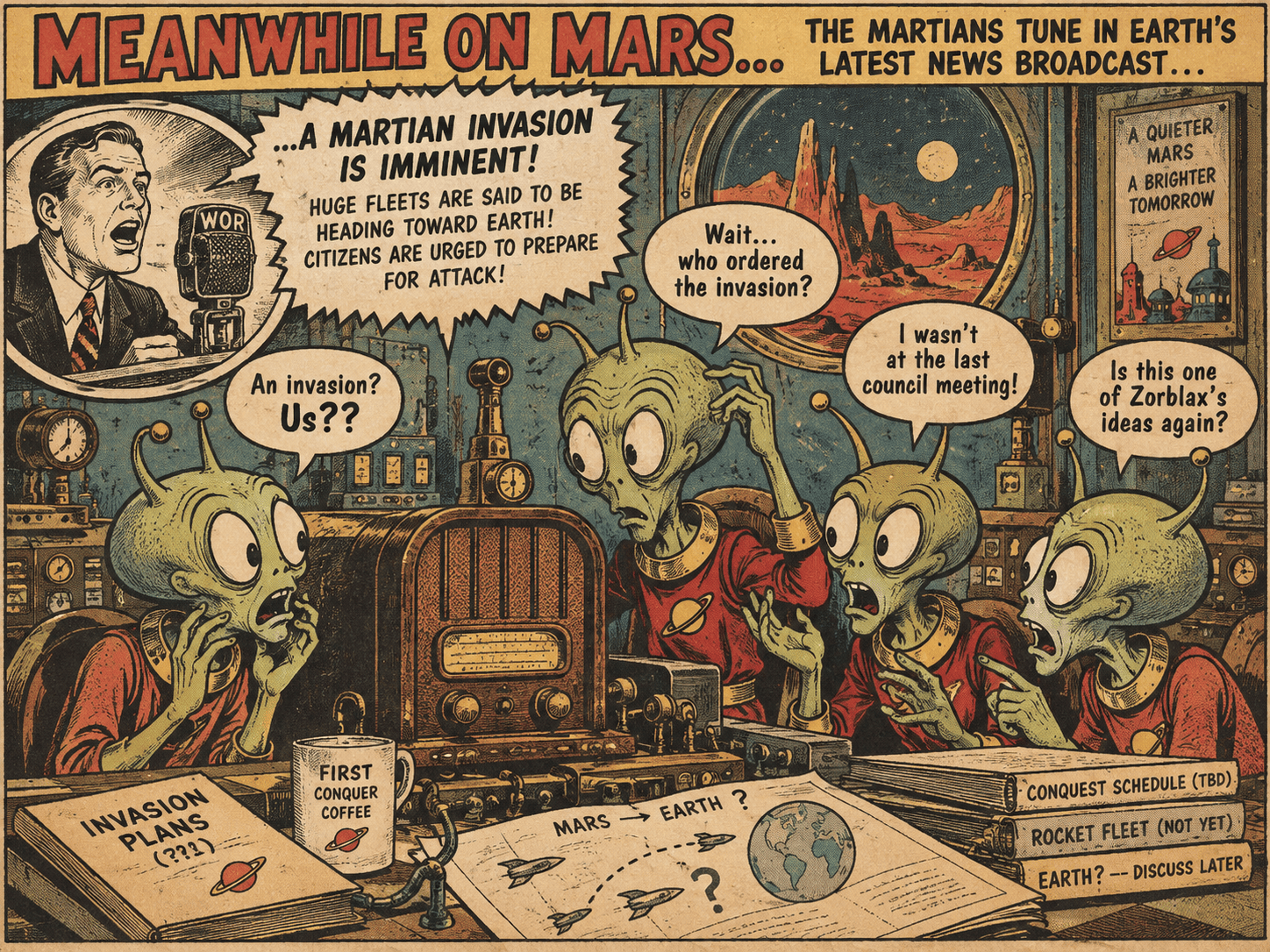
As for the Martians?
Hell, maybe they were listening too.
Thanks for Listening
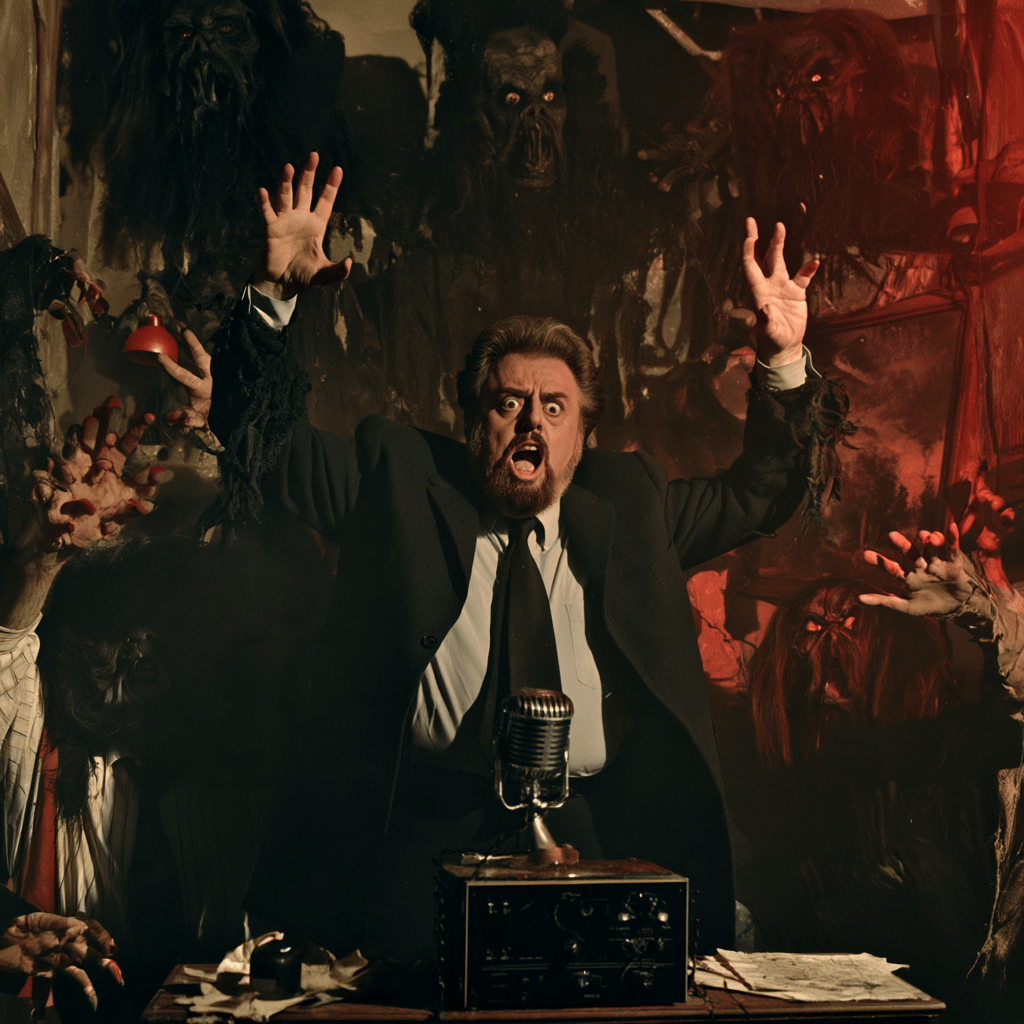
If you made it this far, congratulations, night people.
You survived Martians, panic headlines, dead air, bad information, and nearly ninety years of people arguing over what actually happened.
Not bad for one trip across the dial.
I’m Midnight Mike, broadcasting from KPHO high atop Raven Rock, where the transmitter never sleeps, the static occasionally answers back, and the coffee is thick as oil.
Until next time, keep the volume low, the imagination loud, and whatever you do…
Don’t touch that dial.
— Midnight Mike
Broadcasting from KPHO, Raven Rock
A Note From Management
Midnight Mike is a fictional character and, despite repeated claims that his show can be heard “in places that do not technically have radios,” remains a member of the Cryptic Escape staff.
Mike was created as part of Cryptic Escape’s experiment in character-driven criticism, allowing each of our writers to explore horror, science fiction, fantasy, gaming, wrestling, and popular culture through their own peculiar corner of the Escape.
Any resemblance to an actual radio host, disc jockey, broadcasting historian, paranormal investigator, or individual currently transmitting from an isolated station after perpetual midnight is purely coincidental.
Historical events, quotations, broadcast details, and sources are checked to the best of our ability. Mike’s experiences at KPHO on Raven Rock—including impossible radio signals, broadcasts arriving decades late, voices hiding in dead frequencies, and anything management continues to blame on “the pipes”—should probably not be considered historical evidence or fact.
Cryptic Escape uses AI-assisted tools as part of our creative and editorial process, including research organization, drafting, editing, and artwork. Every published article is reviewed, edited, and approved by a human editor. Final editorial decisions, opinions, creative direction, and responsibility for the published work belong to Cryptic Escape.
— Management
Sources/Research Notes
- American Archive of Public Broadcasting: The Mercury Theatre on the Air; War of the Worlds — Surviving audio, opening and closing identifications, Halloween sign-off.
- Library of Congress: National Recording Registry essay — Broadcast history, Munich Crisis context, competing Bergen program, legacy and 2002 registry selection.
- Library of Congress Magazine: “The War of the Worlds” — Contemporary 5,000-household telephone survey and newspaper coverage.
- Howard E. Koch: The War of the Worlds: The 1938 Radio Script — Program structure, production credits and sound cues.
- Hadley Cantril, with Hazel Gaudet and Herta Herzog, The Invasion from Mars (1940) — Listener interviews, methodology and acknowledged sampling limitations.
- A. Brad Schwartz interview, Princeton University — Listener letters, word-of-mouth effects and Grover’s Mill traffic.
- Jefferson Pooley and Michael Socolow, “Checking Up on The Invasion from Mars” — Reassessment of Cantril and the mass-panic narrative.