
 September
16
September
16
Tags
The Devil Rides Out (1968) – The Night Hammer Horror Summoned the Devil
By Dr. Percy Strout, EU Archive
Spoiler notice: This article discusses major images and supernatural concepts while avoiding detailed treatment of the ending.
I was cataloguing a particularly tedious collection of seventeenth-century demonological pamphlets when I became aware of voices coming from the adjoining reading room. This was not, by itself, cause for alarm. The Archive has voices in several rooms that presently contain no occupants. One learns to prioritize.
I found Veronica stretched comfortably across one of the reading chairs, still dressed in that absurd French maid’s uniform the Archive has apparently appointed as her eternal attire, watching The Devil Rides Out on a television I do not recall the Archive possessing yesterday.
“There is a book,” I informed her.
Veronica glanced at me, red eyes briefly leaving the screen. She shrugged.
“Who has time to read a book?”
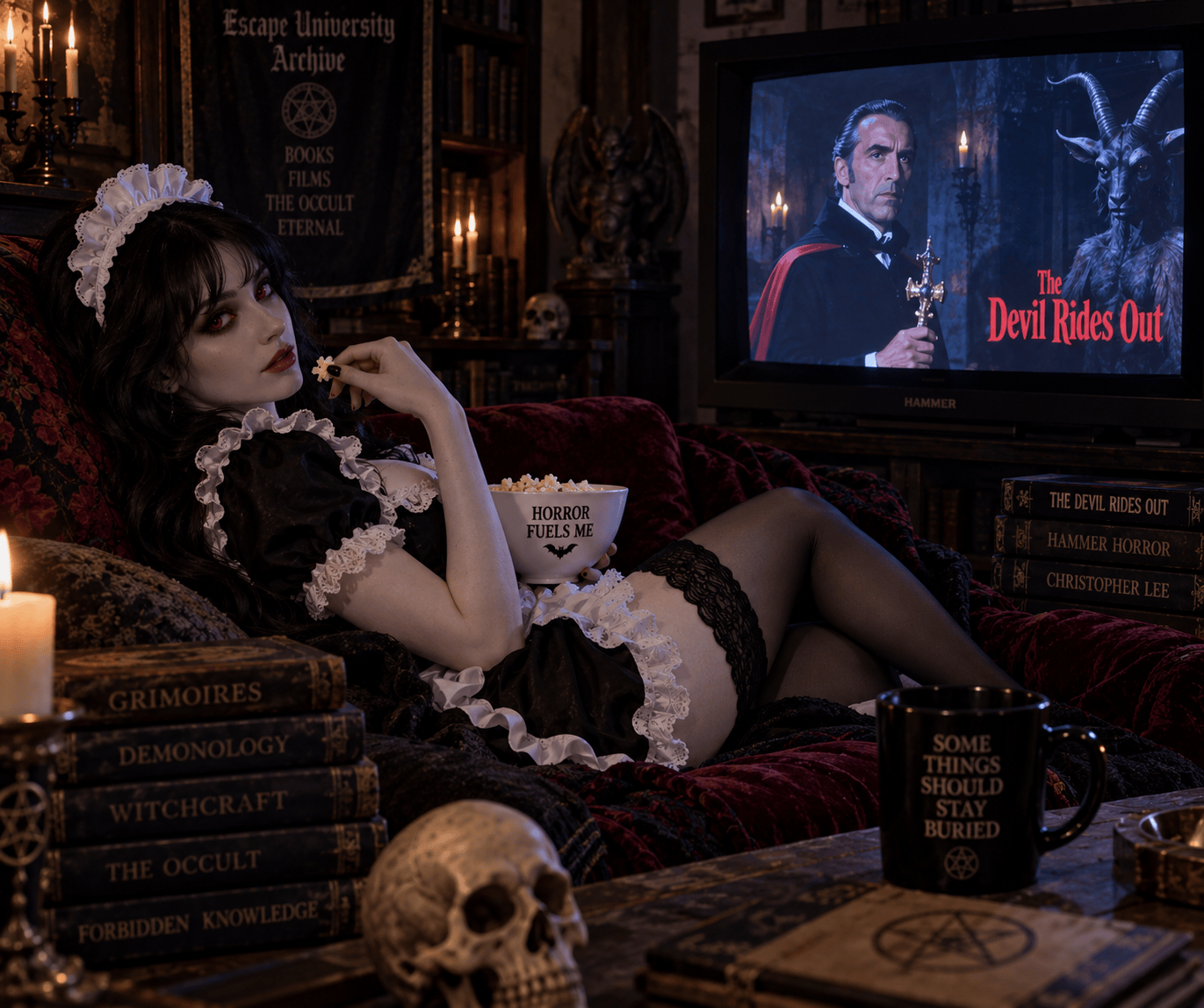
I stared at her.
Then I looked around at the endless shelves disappearing into darkness, the dust hanging in the candlelight, and the corridors of our magnificent prison extending toward destinations I have yet to successfully map.
“Apparently,” I said, “we do.”
Veronica returned her attention to Christopher Lee.
I could hardly fault her for that.
And so, against my better judgment, I sat down.
What followed proved rather more interesting than I expected. The Devil Rides Out, released in 1968 and adapted by Richard Matheson from Dennis Wheatley’s 1934 novel, is, in my judgment, among Hammer’s most serious treatments of occult material. Its seriousness does not arise from documentary accuracy. The film reproduces no single historical magical system, nor does it offer an ethnography of Satanism, witchcraft, or esoteric religion.
It does something considerably more valuable for horror.
It believes in the consequences of its own rules.
Within Fisher’s fictional cosmology, circles matter. Names matter. Knowledge, nerve, timing, prayer, and terror matter. A ritual boundary is not decorative chalk awaiting a close-up; it is a law. A protective circle is, in this respect, less forgiving than a library queue. One need only step out of it once.
Fisher and Matheson construct their supernatural world from ceremonial-magic imagery, Christian demonology, nineteenth-century French occultism, psychical speculation, and Wheatley’s highly moralised mythology of black magic. The materials are eclectic. The direction is not.
Ritual Rules and the Protective Circle
Hammer understood that monsters require rules. Vampires have their prohibitions, werewolves their lunar inconveniences, and the dead their understandable objections to being disturbed. In The Devil Rides Out, however, the enemy is not merely a creature. It is an adversarial spiritual order that must be understood before it can be resisted.
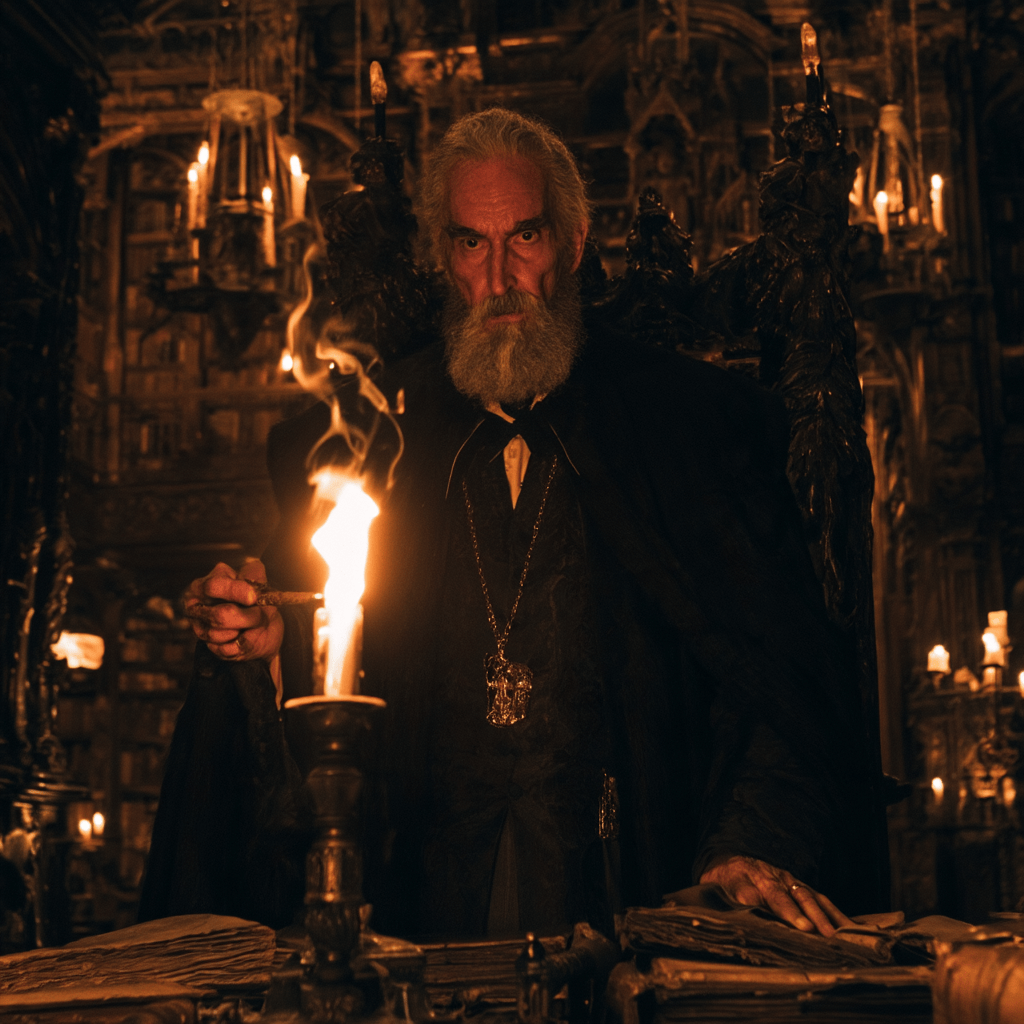
Christopher Lee’s Nicholas, Duc de Richleau, is essential to this conception. He is no casual investigator equipped with a few Latin phrases and an unusually fortunate tailor. He is an authority on occult danger, and the film grants him that authority without a knowing wink. He understands that fear produces error, that evil seduces as often as it attacks, and that technical knowledge without moral resolve is perilously incomplete.
This is not a neutral presentation of esoteric traditions. The film’s moral structure is unmistakably Christian-inflected. De Richleau may employ ritual knowledge defensively, but that knowledge remains subordinate to conscience, faith, and divine authority. Mocata is not evil simply because he understands ceremonial matters; the Duc understands them as well. Mocata is evil because he treats power as an entitlement to domination.
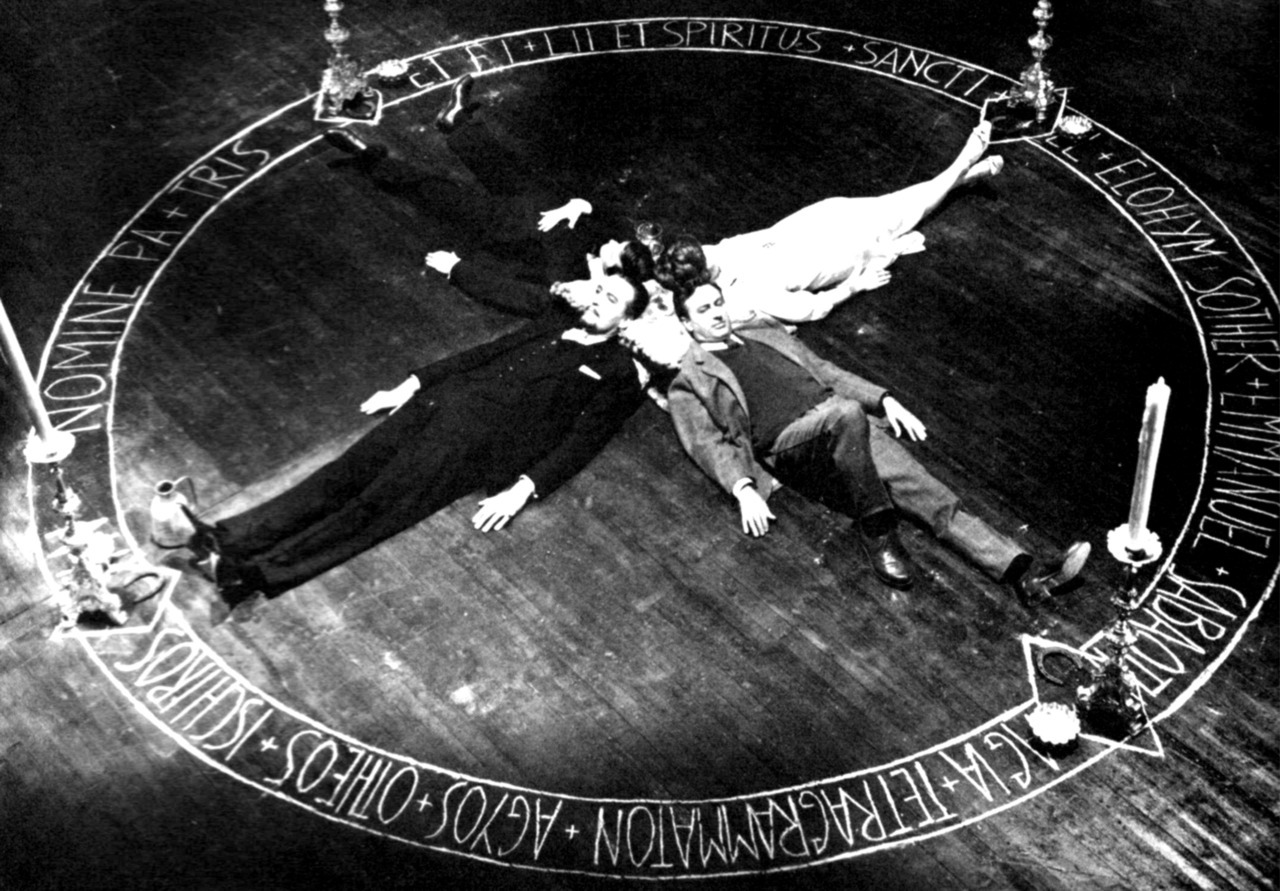
The protective-circle sequence demonstrates this severity better than any exposition could. Within the film’s world, the circle makes invisible danger spatial. It confines the characters, restricts their movements, makes panic consequential, and turns private uncertainty into collective ordeal. Fisher establishes the rule, then lets human weakness threaten it. This is how one makes a chalk line terrifying. Most filmmakers would require a larger budget and considerably less restraint.
The principle has historical antecedents. Medieval and early-modern European learned magic survives in diverse texts commonly called grimoires. Such works could employ circles, sacred names, invocations, ritual tools, directional arrangements, angels, spirits, pentagrams, and triangles. They did not constitute one unified ancient religion, and they were not automatically Satanic. In their learned Christian settings, ritual authority could be expressed through appeals to God, angels, and holy names (Hutton; Klaassen).
The film borrows the logic of such magic rather than reconstructing a particular grimoire. Its markings and formulae should not be certified as historically exact. Fisher’s concern is dramatic clarity, not antiquarian fidelity. Popular fiction, religious polemic, and cinema have often encouraged the notion that every magic circle belongs to organised devil worship. That notion is plainly inadequate to the wider history of ceremonial magic.
The Goat of Mendes: Symbol Made Monster
Among the film’s most memorable infernal images is the Goat of Mendes. Scholarly caution is required here, because Baphomet has accumulated several centuries’ worth of mythology, misinterpretation, and confident nonsense.
The famous goat-headed, winged, partly androgynous figure is associated above all with the French occultist Eliphas Lévi, who published it in Dogme et rituel de la haute magie in 1855–56. Lévi called it the “Goat of Mendes” and the “sabbatical goat.” It was not, however, an ancient and universally Satanic emblem preserved unchanged from remote antiquity. It was a nineteenth-century esoteric synthesis, combining older devil imagery, alchemical and occult symbolism, and Lévi’s own theories of spiritual force (Strube).
In Lévi’s system, the figure represented the reconciliation of opposites: male and female, above and below, spirit and matter, light and darkness. It was also connected to his Astral Light, a hypothetical medium within his magical philosophy. Whatever one makes of that doctrine—and empirical evidence has been notably unwilling to cooperate—it was not merely a portrait of the Christian Devil.

The familiar association between goat imagery and the inverted pentagram developed over time. Lévi had already indicated the connection; Stanislas de Guaïta later visualised a goat-head pentagram variant in 1897 (Strube). Hammer’s Goat of Mendes is therefore a cinematic translation, not a historical preservation. Wheatley and Fisher convert Lévi’s philosophically overloaded symbol into a literal infernal manifestation within a Christian demonological universe.
This simplifies Lévi rather drastically. It also makes excellent visual sense. An ambiguous emblem of cosmic equilibrium is not naturally suited to terrorising a country house unless one intends to provide the audience with a seminar first.
Fisher wisely gives them the goat.
Wheatley and the Satanic Imagination
The cult in The Devil Rides Out is similarly composite. Its ceremonies combine the imagined witches’ sabbath, anti-Christian inversion, secret societies, aristocratic decadence, sexual danger, and literal diabolic intervention. These elements have histories, but they do not provide evidence for a continuous historical religion of Satanism.
The early-modern learned conception of the witches’ sabbath was substantially shaped by Christian demonology and witch-trial culture, although its formation is more complicated than any single origin. It gathered fears of heresy, conspiracy, illicit sexuality, and rebellion against God into a potent fantasy of collective diabolism. Later literature, occult revivalism, and popular entertainment transformed it further.
The Black Mass is equally unstable as a historical category. Hostile religious accounts, scandal literature, fantasy, and later ritual movements have all contributed to its changing forms. Hugh Urban traces this development from Christian polemic and imagination into modern cultural and ritual expressions, rather than treating the Black Mass as one practice transmitted unchanged through the centuries (Urban).
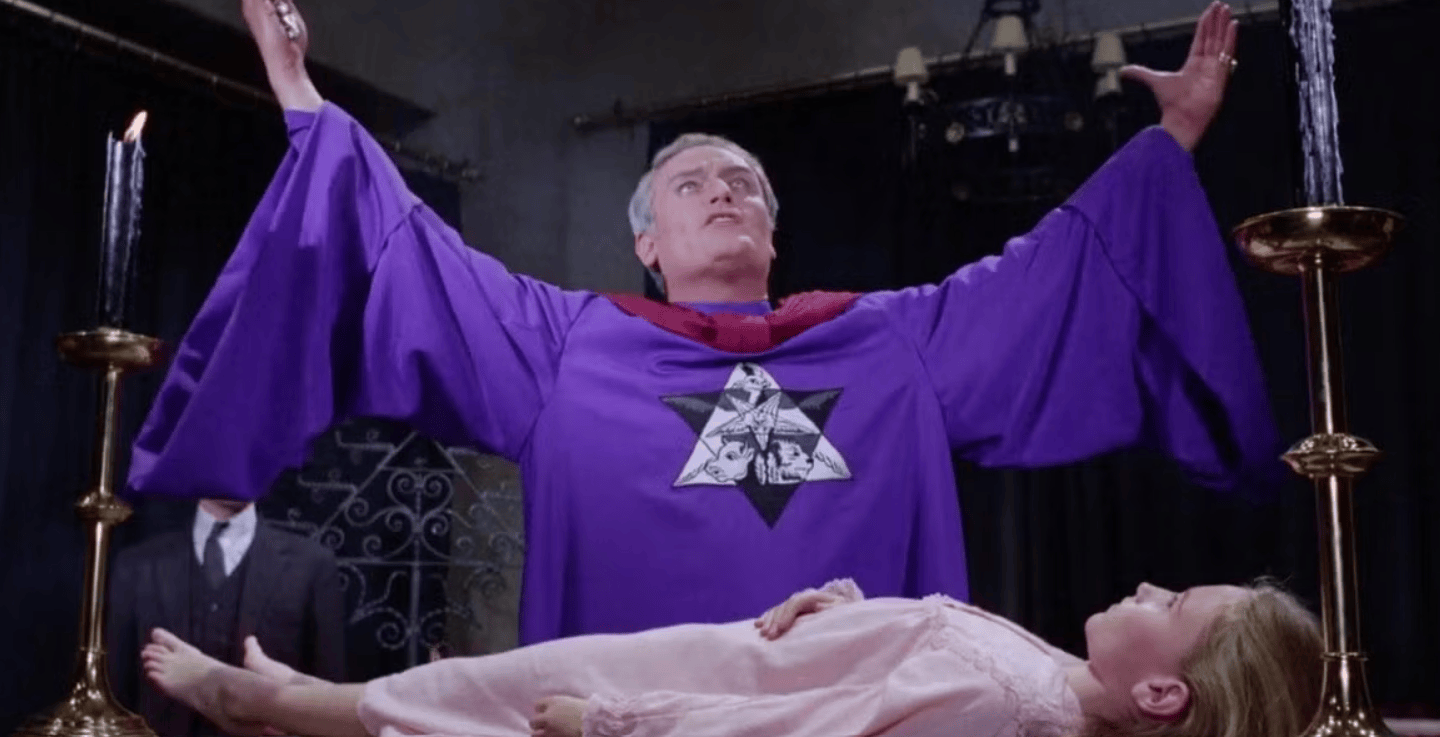
Dennis Wheatley did have a sustained interest in occult and psychical subjects, including membership in the Ghost Club (The Ghost Club). Such interests establish curiosity and participation in psychical-research circles; they do not establish that he was a practising magician, possessed secret knowledge of Satanic rites, or provided evidence for supernatural claims. Literary enthusiasm has ruined enough respectable evenings without becoming metaphysical expertise.
What Wheatley unquestionably possessed was cultural influence. Bernard Doherty identifies his fiction as a major conduit for popular British ideas about Satanism and analyses how Wheatley’s demonology reflected anxieties concerning class, nationality, race, gender, sexuality, religion, and social order (Doherty). Hammer inherits that mythology of Satanism. It does not document historical witchcraft or a surviving ancient cult.
Astral Danger
The film’s psychic coercions, visions, monstrous apparitions, and assaults across distance belong to the same hybrid supernatural system. Within Fisher’s fictional world, invisible forces can be mental, spiritual, visionary, and apparently physical at once. Fisher declines the easy reassurance that every alarming experience must be merely hallucinatory.
Astral ideas have older astrological and cosmological antecedents, but the forms most relevant here belong to nineteenth- and early twentieth-century Western occultism—particularly Lévi’s Astral Light and later doctrines of subtle planes or bodies. These were systems of esoteric belief and speculation, not empirically verified descriptions of the universe.
Fisher combines them freely with Christian demonology and Gothic spectacle. The result would not satisfy a theologian, a historian of magic, or indeed a reasonably alert goat. It does satisfy the dramatic requirement that supernatural danger feel governed rather than random. The effects may now invite affectionate scrutiny, but their conceptual function remains formidable: metaphysical peril has purpose, agency, and rules.
Christopher Lee Against Charles Gray
Lee’s performance gives the film its spine. Hammer had made him famous through monsters and villains; de Richleau offered the comparatively rare opportunity to play a heroic and morally upright authority (Hammer Films).
His power comes from restraint. De Richleau does not present occult knowledge as colourful eccentricity. He behaves like a man for whom the stakes are already obvious and whose time is too valuable to waste explaining them to fools. Lee makes the supernatural procedural. A warning is not a flourish but an instruction; a ritual is not pageantry but necessity. Terror becomes credible because the Duc is frightened only when fear is warranted.
Lee’s own public discussion of occult subjects is relevant, though it ought not to be inflated into proof of private initiation or supernatural expertise. In a filmed interview about the occult, Lee brings the same gravity and fluency that made de Richleau persuasive on screen (Christopher Lee interview). That is useful evidence of an actor’s interests and public persona. It is not corroboration for occult claims, nor a master key to every performance choice. An actor need not produce a peer-reviewed demonology, however superior his voice may be to those who have attempted one.
Had the part been played more flamboyantly, The Devil Rides Out might have become parlour-room melodrama in ceremonial robes.
Charles Gray’s Mocata provides the necessary counterweight. He is urbane, controlled, intelligent, and socially plausible. He does not snarl or cackle with the diligence of a pantomime villain. His composure makes him more disturbing. Lee and Gray turn their conflict into an argument between rival certainties: both understand power, but only one accepts that power must answer to something beyond itself.
That is the film’s deepest conviction. Technique without conscience is tyranny, however elegantly performed.
Seriousness Without Credulity
The Devil Rides Out endures not because it accurately represents an occult tradition—plainly, it does not—but because it takes its borrowed materials seriously enough to make them frightening. Grimoire logic, Lévi-derived imagery, Christian demonology, astral speculation, and Wheatley’s moral imagination become a coherent dramatic machine.
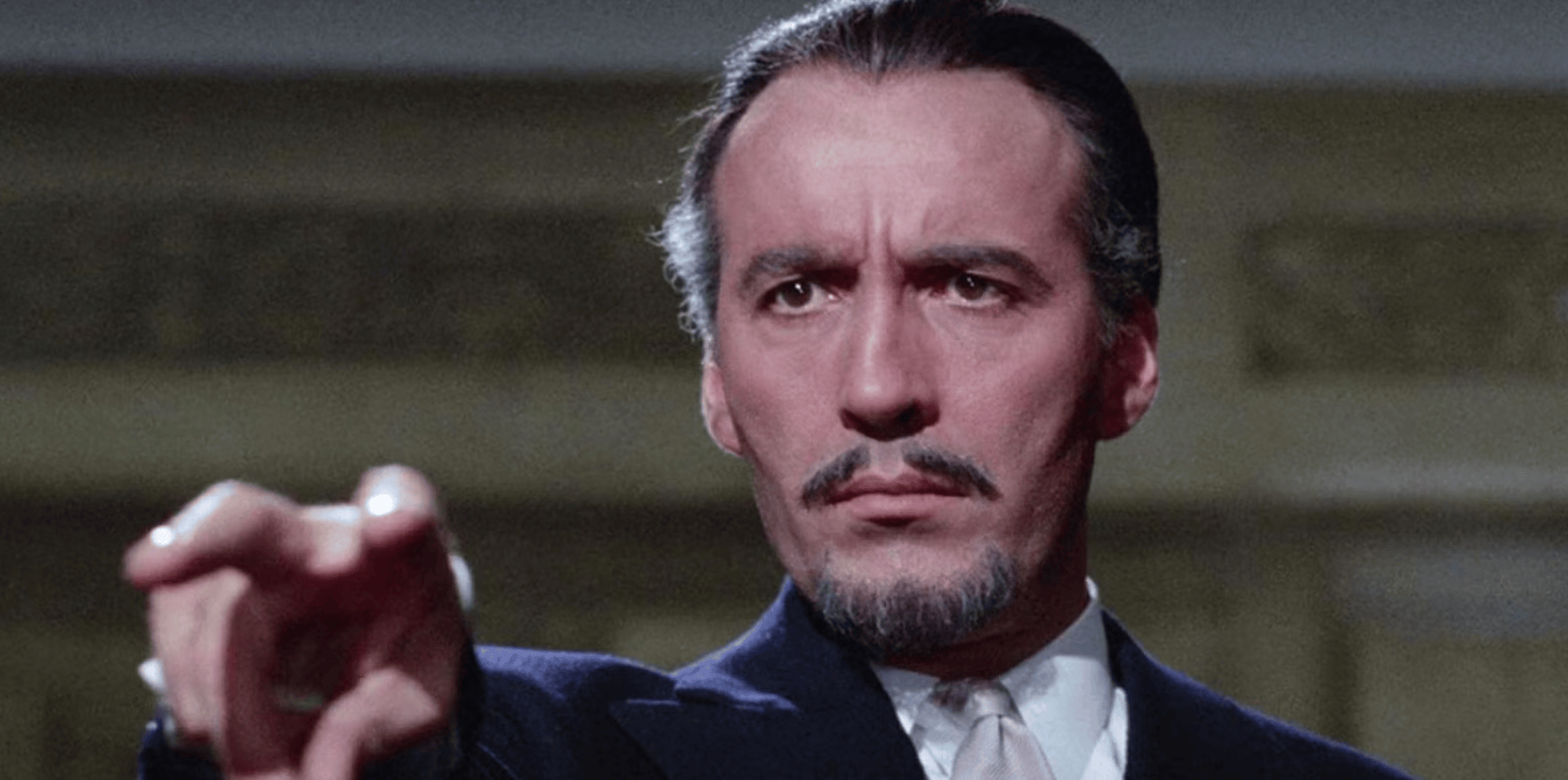
Fisher refuses to laugh first. Lee refuses to preen. Gray refuses to overstate. Their discipline gives the symbols weight.
That weight is not evidence that demons exist, that protective circles function, or that the Goat of Mendes waits behind the nearest hedge. It demonstrates a simpler truth: horror gains force when its makers understand that the ridiculous and the terrifying are often separated only by the firmness with which one draws the circle.
I could, of course, continue. The occult history surrounding The Devil Rides Out offers enough material to occupy several volumes—and, regrettably, several scholars. I have chosen instead to concentrate upon those elements I consider most important to understanding the film: the protective circle, the Goat of Mendes, Wheatley’s Satanic mythology, its astral cosmology, and the authority Christopher Lee brings to it. Completeness is admirable in an archive. In an article, one must occasionally have the good manners to stop.
There is presently a disturbance somewhere beyond the eastern stacks. Veronica assures me it is merely one of the ghouls. The ghouls, for their part, have never demonstrated sufficient intelligence to knock before entering.
I believe I shall investigate.
The cataloguing can wait.
A Note From the Administrator
Dr. Percy Strout is a fictional character and, despite his repeated complaints to the contrary, remains a member of the Cryptic Escape staff. His journals reach us from somewhere inside the Archive.
Percy was created as part of Cryptic Escape’s experiment in character-driven criticism—allowing each of our writers to approach horror, science fiction, and fantasy.
Any resemblance to an actual occult scholar—living, dead, undead, or currently cataloguing something that should have remained buried—is purely coincidental.
Historical claims and sources are checked to the best of our ability. Percy’s experiences inside the Escape University Archive, including vampires, ghouls, impossible architecture, and questionable employment practices, should probably not be considered historical evidence.
Cryptic Escape uses AI-assisted tools as part of our creative and editorial process, including research organization, drafting, editing, and artwork. Every published article is reviewed, edited, and approved by a human editor. Final editorial decisions, opinions, creative direction, and responsibility for the published work belong to Cryptic Escape.
Sources/Research Notes
- British Film Institute, “The Devil Rides Out (1967)”; BFI Player, “The Devil Rides Out (1968)”. The catalogue’s 1967 date reflects production/cataloguing; the film received its UK commercial release in 1968.
- Christopher Lee, filmed interview discussing the occult.
- Bernard Doherty, “Black Magicians and Foreign Devils in Little Britain: Dennis Wheatley and the Invention of British Satanism,” Aries 24, no. 1 (2023): 29–57.
- The Ghost Club, “History.”
- Hammer Films, “Christopher Lee 1922–2015.”
- Ronald Hutton, “Finding a High Magic,” in The Triumph of the Moon.
- Frank Klaassen, The Transformations of Magic: Illicit Learned Magic in the Later Middle Ages and Renaissance.
- Julian Strube, “The ‘Baphomet’ of Eliphas Lévi: Its Meaning and Historical Context,” Correspondences 4 (2016): 37–79.
- Hugh B. Urban, “The Age of Satan: Satanic Sex and the Black Mass, from Fantasy to Reality,” in Magia Sexualis.
You must be logged in to post a comment.